Well, regardless of degrees in ecology, I'll happily admit that ‘plant ID’ was never going to be my forte. I mean seriously, squinting through a hand-lens, trying to see if a ligule is hairy or not, or where it is, or deciding if a corolla is tubular, galeate, labiate or bilabiate. And don’t even get me started on inferior ovaries and stipules. Nah, you can keep all that, I’ll leave that to others.
But I can tell if they’re pretty and, as a photographer interested in natural beauty, flowers are a tempting proposition. You’ve got a head start on pretty surely! Whilst this is true I often find many published pictures of flowers, like most birds for that matter, leave me cold. I want to see something a little bit inspiring, even perhaps ‘arty’, rather than clinical or forensic. I'm not saying I can do that, but I do try. There are only a few examples here at the moment sadly as, like fungi, they require lenses that I just don’t normally carry when seeking birds.
Of course, photographically, plants bring their own problems. Sure, unlike birds and animals, plants don't run or fly away, but this doesn't mean they are motionless, oh no, far from it indeed. The merest breeze and you’ve got leaves and flowers flapping around all over the place, So you’ll need a high shutter speed, but of course, if you’re close-up don’t you want a small aperture for depth of field too? Why, yes you do. See the problem? And things like tripods and image stabilisation ain't gonna help in the slightest, because it’s the subject that’s moving, not the camera. This also means of course that you cannot use the delights of focus-stacking, which is an absolute bummer because that would be amazing. OK you could cut the flowers, stick in a vase in a studio, or maybe in a greenhouse. But that wouldn’t really fit the ‘in’ bit of pulchritudo in natura would it!
Oh, stop making excuses and get on with it I hear you say. OK.
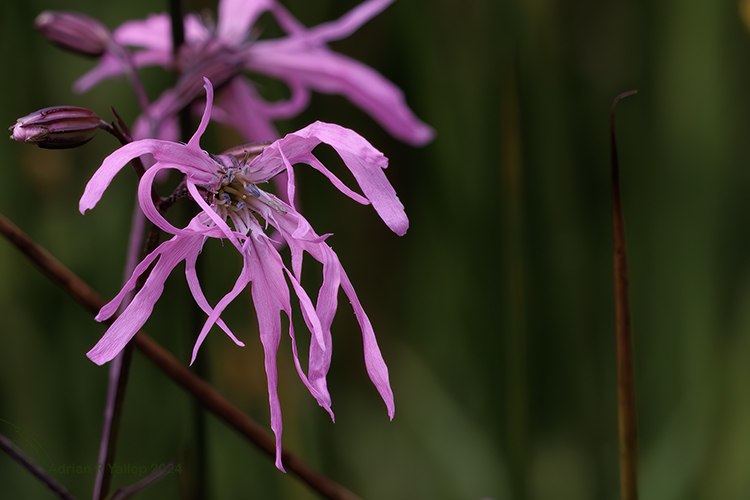
Lychnis flos-cuculi Ragged Robin: two flowers and half a buttercup.
If there was any flower that first made me stop and really look, (excepting a nettle perhaps when I was three) I think it might be this one. It just looks so ragged, you might even think that’s where it got its name! Most flowers seem to try for some sort of visual, or presentational, perfection, ragged robin just looks like it couldn’t be arsed, and just threw something on. That’s probably why we got on together so easily.
I used to work on the Norfolk Broads (oh, they aren’t natural you know, nope, all man-made - if you didn’t know that then you've learned something today, hang-around there may be more!). Anyway, ragged robins were a common sight in my early life, but when I moved, I sort of missed them. Then one sunny day, walking past a lovely wet meadow near where I live and there they were my favourite flowers, and a lot of them. I was back next day with camera to immortalise them in bits, somehow appropriate for this ragged beauty.
I choose this composition, aligning the two flower heads, one in focus, one out, and cropping to include just half of that solitary creeping buttercup because I like it, why else?
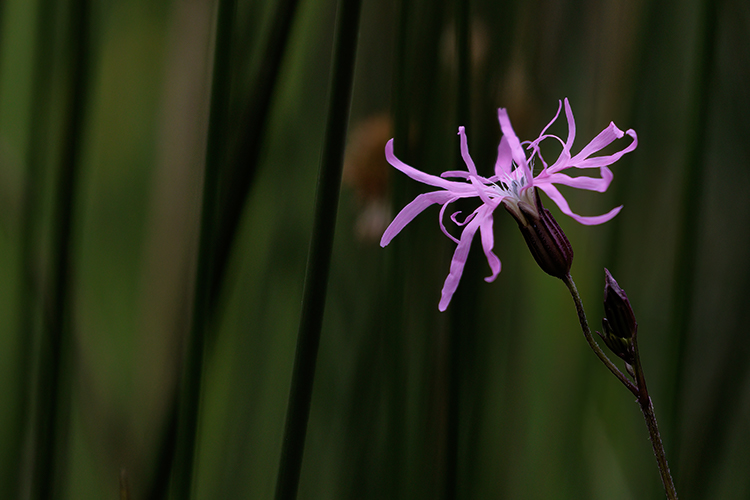
Lychnis flos-cuculi Ragged Robin: lone guard.
Now I’m beginning to think that I may perhaps have made getting this set of images seem too easy, and I like to show the pain in my ‘art’. This flower was 6 inches the other side of a barbed-wire fence, alongside a very muddy little ditch then a road. So, I had to lay with my elbows in the mud and the rest of me across the road. Then align the lens with a gap in the fence. Why not go into the field you ask, surely that would have stopped you moaning? Well kindly allow me to explain if I may. The field was occupied you see by six or seven bulls, all of who seemed ready to show their superior ‘manliness’ to the others by seeing who could trample me the farthest into the mud/bullshit combo of the field. Death by being run over might have been a similar experience for sure, but at least I wouldn’t smell of bullshit at my funeral. See the complex mud/shit/death-defying efforts I go to simply to bring you a pretty picture?
This little chap fills the middle of the three I’m going to put in. I think the solitary pink against green makes it a good alternate to the one above.
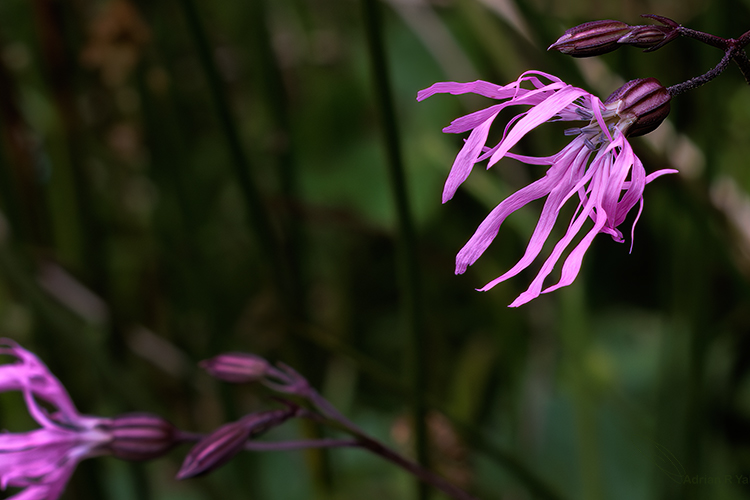
Lychnis flos-cuculi Ragged Robin: not sure.
I am far from sure about this one, I liked it at the time I took and ‘developed’ it, but now, not so sure. I’ve popped it in but look quickly, it may soon be gone.
Oh, apropos of not much at all, the flos-cuculi of the scientific name literally translates cuckoo-flower, of course the cuckoo-flower itself has the specific pratensis, which means ‘of the meadow’. It’s all too odd, frankly it seems like the Puffin’s name all over again.
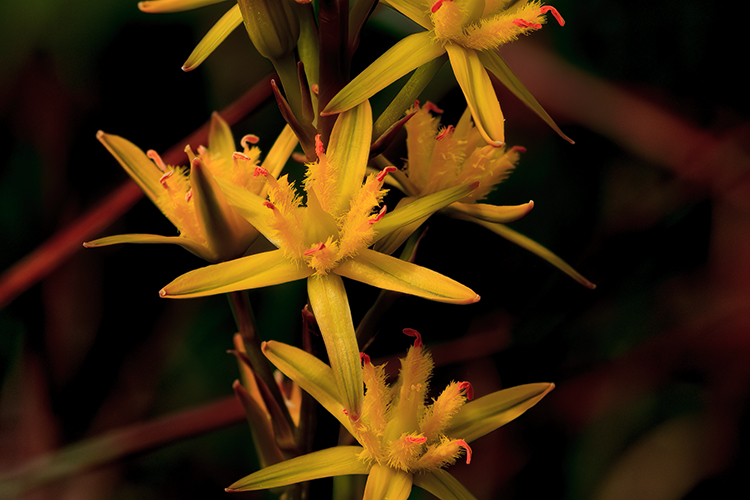
Narthecium ossifragum Bog Asphodel
I suppose whilst we’re lying (well I am) in the wet stuff we ought to go through the other wetland specialities. This beauty was waiting for me, alongside several hundred of his chums, on a stretch of bog near the Mires of Skurron (Shetland, not Mordor!). Getting close up and personal, or rather down to his level, was the only way of course. So goodbye dry clothes. I took this in a vertical, or portrait, orientation because it just fit the subject, and besides, at that point, I never thought I’d try to put together a website that made using vertical shots problematic.
Anyway this horizontal crop will open up into the full image.
Of course, as I write this, I worry that the whole site might be gone now. Large tracts of Shetland have recently been destroyed by tax-payer funded greed, or a wind farm as they are often called. It’s ironic isn’t it that Shetland has hosted the evils of ‘Big Oil’ at Sullom Voe, one of the largest oil and gas terminals in Europe, for nigh on 50 years without any significant ecological damage, and yet the so-called ‘green’ energy has covered it in concrete, decaying bogs and aesthetically ravished landscape in less than a decade. Well done muppets, I hope you're happy. Now, where's that damned number for Majestic Wine again?
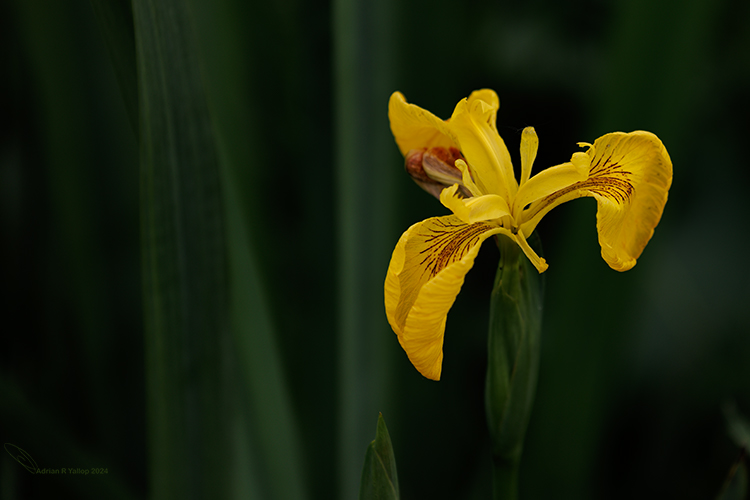
Iris pseudacorus Yellow flag or Flag Iris
I think I’m going to finish up saying ‘this is my favourite plant’ several times. So this is another one of them! Such a big bold and bright native plant. And one I used to love seeing in abundance on the fens of Norfolk, and now around where I live too. "If you like them so much how come you don’t have a truly glorious picture of them I hear you say, esp as you have a lot growing alongside the stream beside your shed?" Stop asking impertinent questions.
Compositionally, I do prefer individuals, or small groups with plants. Sure Iris pseudacorus can create great swathes of colour in wet rough pasture and along undredged streams and rivers. But I seem to lack the technique to capture that sort of landscape image. I have to try harder. Anyway this solitary chap growing alongside a little nearby stream caught my attention. Not sure I’ve got him right. I will try again.
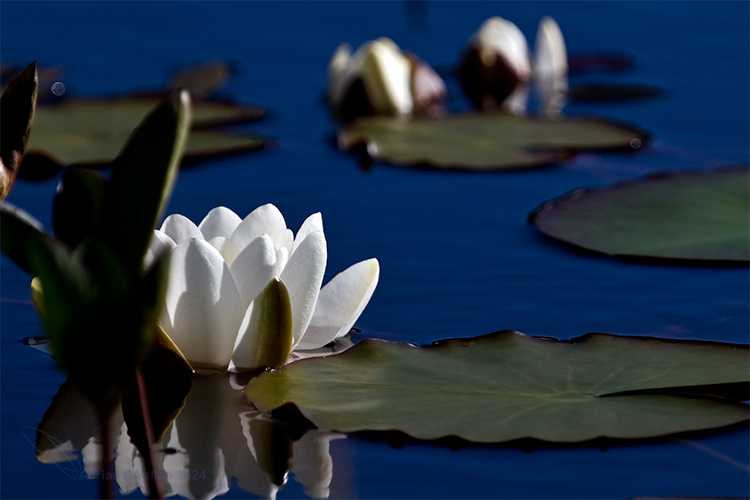
Nymphaea alba White Water-lily
Continuing the informal ‘wet theme’, in this case totally immersed, is the native white water-lily, that jewel of lakes, pools and slow moving waterways, one sufficiently beautiful to inspire Claude Monet to paint some 250 paintings. Well, I clearly can’t match his talent, but I can still find Nymphaea alba beautiful and inspiring. So when I came across these gems occupying an extensive series of natural pools south-west of West Burrafirth (Shetland) I had to try to capture that beauty, in electrons rather than oil.
It is a perfect warm sunny day, clear blue skies (these things do happen there!). I start taking a few then I notice that Julie is relaxing in the sun and reading, so I have time, no need to rush.
To represent this beautiful plant, in such a beautiful place, I’ve chosen this example. Sometimes, exposing to capture the detail in bright white subjects such as this, especially on a bright sunny day, leads to poor dark backgrounds. Here though, I think, the darkness of the water, and the depth of colour it brings to the image, just add to the overall picture. Well, I do, and as we know, it’s my website!
Filipendula ulmaria Meadowsweet
Is there a sweeter-smelling plant than this I wonder? In summer, this species fills the air with a glorious perfume. It has also rightly been called Queen of the Meadow, Lady of the Meadow, as well as Bridewort. The latter because the flowers were often spread in church as a carpet for a bride to walk upon, that natural subtle sweet scent must have smelled lovely.
While thinking how best to capture a few images of this species, I stood on the edge of a wet meadow richly perfumed with meadowsweet's delicate natural fragrance, just breathing it in, enjoying its subtle sweetness. Suddenly, the smell equivalent of the raucous scream of an air-horn wipes it out, filling my nose with an overwhelming chemical pollution. Moments later two cyclists pedalled past. I’m not kidding, you could smell that overpowering malodorous chemical ordure for minutes after they’d passed. Why do people wash their clothes in such grossly over ‘perfumed’ chemical crap? I suppose it gives their children, and everyone else around them, a reason for having asthma inhalers. Just stop doing it folks, seriously. There is simply no need to.
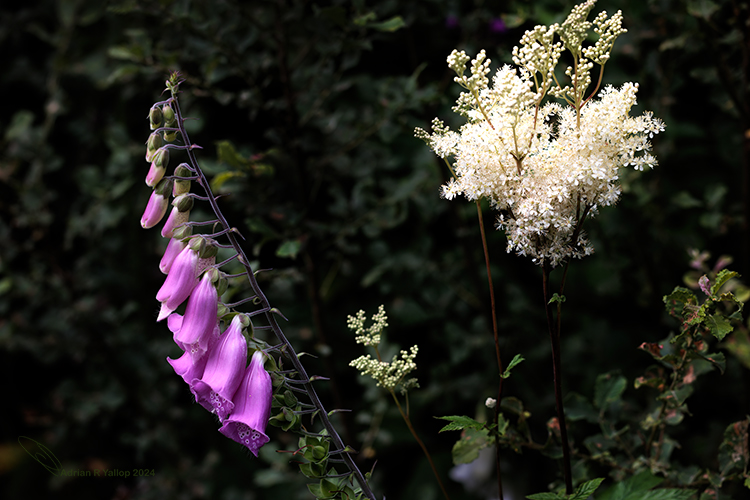
Meadowsweet is a plant of subtle beauty, and after I'd cleared my nose and lungs of the passing stink I spent a long time thinking how to try and capture this, close-up, or farther away. Well the first here was an idea to mix in some colour from another species as a contrast to the white purity. I sort of like it, a bit anyway, even tho’ I can see now the two species should have been the other way-around, with the Digitalis on the right and facing (admiring), the meadowsweet. Isn’t it annoying when you do that! 5 out of 10 for effort.
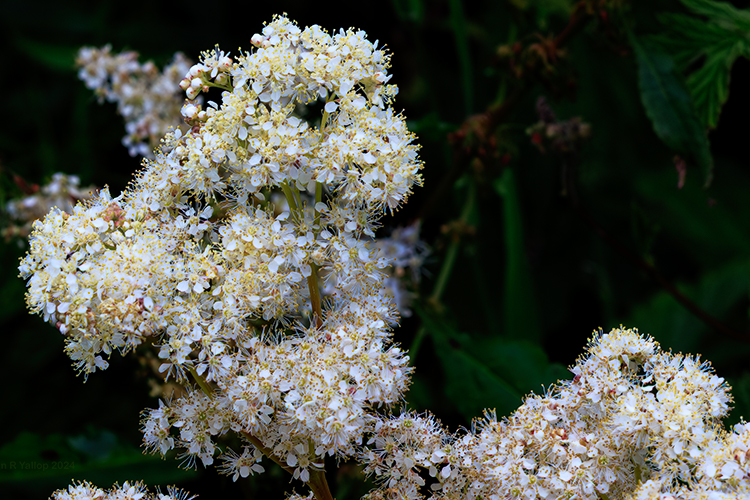
Filipendula ulmaria Meadowsweet
As a second picture I’ve tried a modest close-up, to show that maze of tiny flowers. This is a problem really, flowers such as these are tiny. Get in too close and you lose all the context of the hundreds all crammed together in a tiny space. Each one doesn’t amount to much visually, it is only when they are all assembled together, in a complete flower-head or inflorescence, that the ‘magic’ happens.
I often wonder how insects like bees get on with such species, each individual flower must contain the most minutest amount of nectar, and going from one to the next, to the next, to the …….(repeat forever) must be energetically inefficient. Next time I see a bee on one I’ll ask her, or whatever the new mandated woke bollox pronoun for a sterile female is. I shudder to think. Hopefully it is something like we're all doomed, I might start using it.
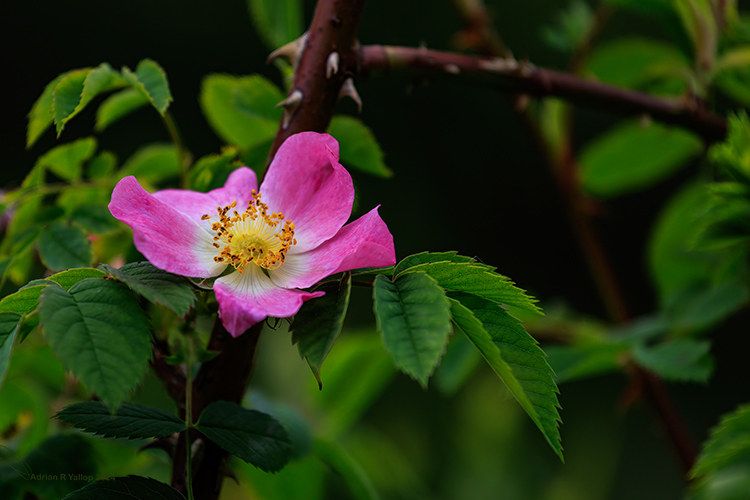
Rosa canina Dog Rose
Well, as we’re in the rose family, I suppose we better have one carrying the name. This lovely specimen was in fact mere metres from where its ‘cousin’ above was snapped.
I have to show my appreciation of the subtle over the gross here (those who know me might find that idea contrary to their judgments) as I find the beauty of this simple ‘original’ rose form worth a million of the gross cultivar ‘tarts’ that adorn garden centres and far too many gardens.
I will admit that I do find them harder to love when trapped in those thorns after falling into them whilst crossing a fence!
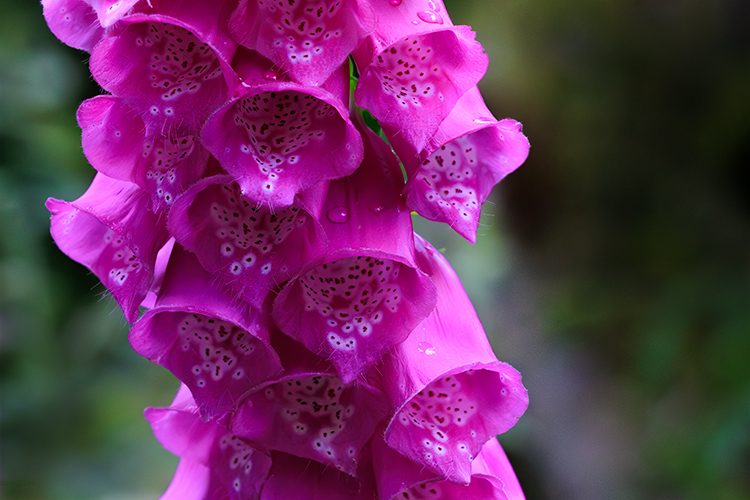
Digitalis purpurea Foxglove
I hope the previous image of a foxglove sharing the limelight with meadowsweet is a good enough visual segue to this species in its own right.
Like many a tall thin plants, I find Digitalis, with its especially tall and slender flower-spike, a real challenge to try and ‘capture’. If you want to ‘get’ the whole thing, you miss the detail of each flower, anyway as it flowers in sequence from bottom to top there’s always a lot of unopened buds and the top and unsightly senescing flowers at the bottom. What to do, what to do?
I thought “bugger-it, it’s raining, this’ll do”. Well not quite, but actually close to. I’ve stared at these plants many many times, and indeed I have hundreds of full-length and close-up images, but I don’t like any of them that much.
This is the nearest I think, the background suits the pink/magenta of the flowers, the odd shining rain-drop and, for once there’s not a bee’s bum sticking out of one of the flowers!
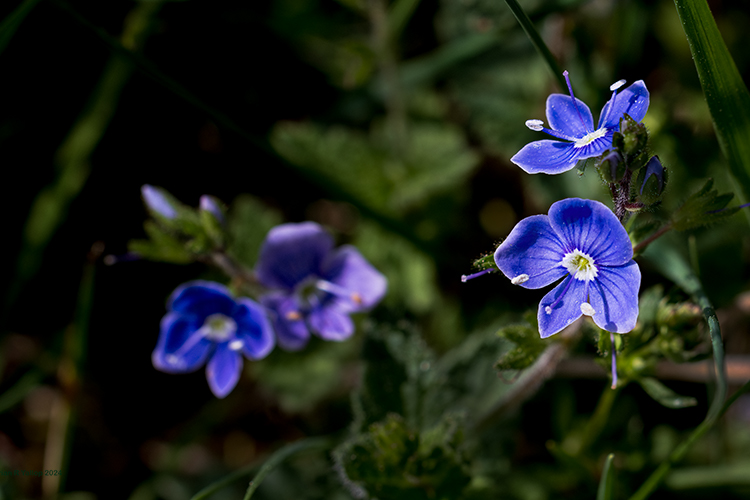
Veronica chamaedrys Germander speedwell
Well I’ve slipped these in, not because I’m getting bored with pinks and whites, but because these little plants, usually mere inches high, are in the same family as foxgloves. Isn’t evolution a truly marvellous thing, either that or the taxonomy is simply wrong!
And yes, these are my favourites too, those tiny blue jewels hidden deep in the grass of meadows and verges.
Thing is, and yes, I’m going to moan again, the little buggers dance about in the slightest breeze, so you need a bright day if possible and that makes everything so contrasty and harsh. So the upshot is I’m not fond of this picture, but it’ll stay to embarrass me to get a better one, seeing that it’s my favourite flower and all!
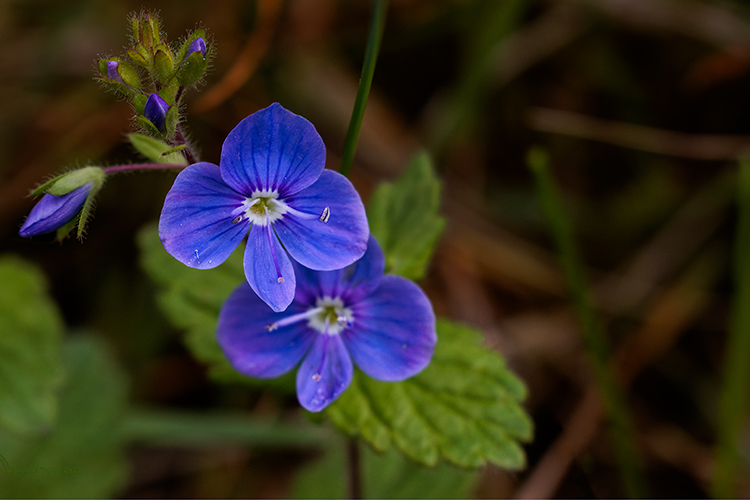
Veronica chamaedrys Germander speedwell
I can’t say I love this picture much either. Sure the lighting is less harsh, and that’s for the good, but it still lacks enough depth of field. Something not always possible with little flowers like these as you need the shutter speed to try and stop the flower’s demented dancing, and you can’t ‘focus-stack’ for that reason, and (if I’m allowed another one) you’re trying to keep the ISO modest.
Nevertheless I should have tried a couple more f-stops. I am still nervous about noise, like many older folk getting used to the freedoms of digital image capture, I mean in the days of film getting a 1000 iso would have been nigh on fantasy, and if you did ‘push’ that far the images were just crap! Modern noise reduction algorithms, like those in DXO and Adobe Photoshop are simply breathtaking, so I should have tried. Next time!
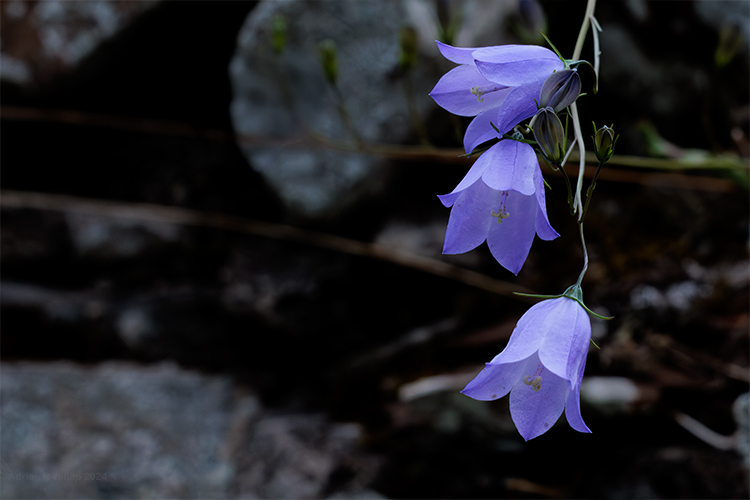
Campanula rotundifolia Harebell
What a delicate beauty, oh and it’s called Scottish Bluebell up here. In late summer it used to fill the margins of the road I walk daily, glorious.
I say used to because Highland Council, now flail the verges to death in summer, just when the flowers are in bloom, truly cretinous behaviour. There can be no safety concerns here, the vegetation is only around 18 inches at most, it is a straight single track lane. No, it is just the usual soul-numbing incompetence. These are most councils' superpowers but Highland got a double dose. God alone knows what their ecologists are paid to do, probably attend endless meetings about gender-alignment issues in the workplace. Is it time to open a bottle yet?
Anyway, as a result of this tax-funded extirpation of nature, these flowers, much reduced in number, only hang on by growing amongst the wire fencing. This makes them safe from the flail, but hardly a photographically appealing subject.
Then I noticed a couple growing on top of the wall of a small cemetery, where they draped beautifully against grey stone. This was the picture I wanted, and I like the result. It is a different view of this species, normally they’re erect. I like it all the more because this delicate gem got one over on the council. It can only be a matter of months before they're back with herbicide, or a flamethrower.
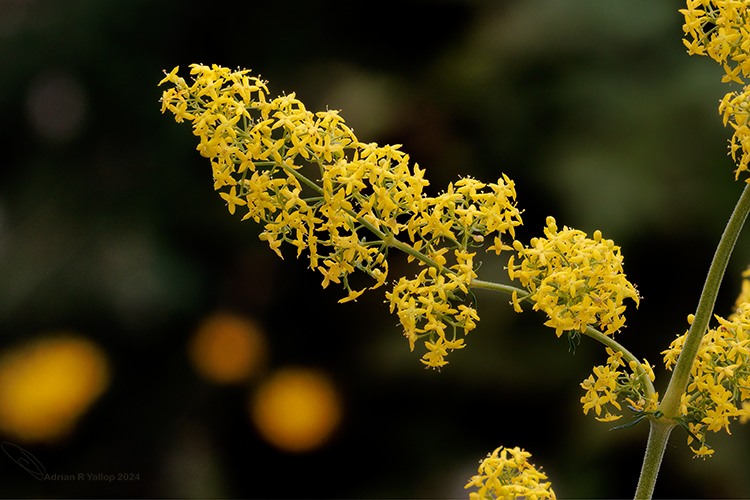
Galium verum Ladies bedstraw
OK, I’m coming to the conclusion, one no doubt you reached ages ago, that probably all native flowers are my favourites, cos this one is too! Such a delicate-looking species, with a simply beautiful scent. I imagine the ladies who had their beds filled with these flowers had heavenly dreams, unless they had hay-fever.
Anyway, I’ve followed the Harebell with this species because it too was once abundant alongside the same road, but now experiences the Highland Council extermination every year, and hangs on courtesy of the same wire fence. I think if they really want to do the job properly they will need to rip that fence out.
This is one of those plants begging for a vertical image, which don’t work well on this site. So I solved that by framing one of its many side stems, cunning or what? I like the four background buttercups that provide more colour to the image, I just wish I could convey the scent too.
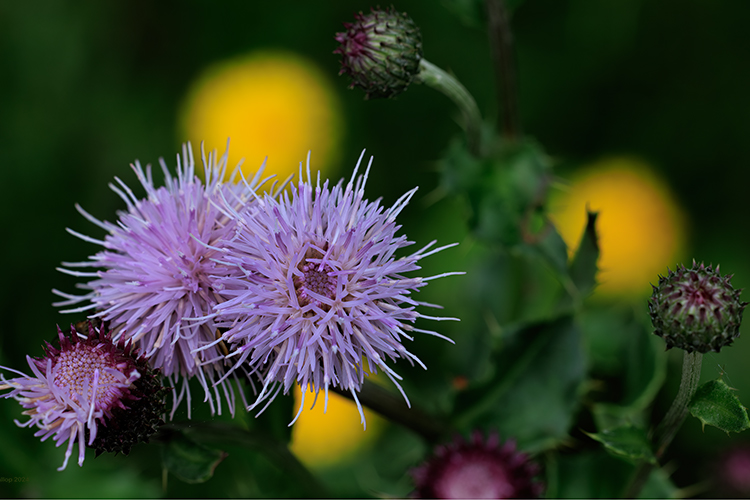
Cirsium arvense Creeping thistle
Well I guess that overall, in total, nobody will love a thistle, the size, the amount of ‘greenery’ and well, the prickly bits! I once watched one of our cats (Stripey) tread over a tiny thistle in the cracks of the paving. It obviously ‘bit’ his foot as he jumped and leapt a couple of steps away. Clearly annoyed he turned, frowning, to look back to see who had done it. Slowly he returned to where it had happened, then cautiously tapped the spot with a paw, it bit him again and, sure enough, he jumped away again. This was clearly begining to piss him off, no bloody plant was going to try to claim dominance in his territory. He went forward slowly again, tap, paw jerk and jump. Well he was really getting mad now, again he steps forward and really twatted it one! Only to jerk his paw back again. Dim he may have been but he was tough, and he returned to it again, but this time battle-lines were drawn, there would be no more retreats. Standing his ground he examined it again. Twat (ouch), another (ouch). By now I could barely breathe with laughter. Cat versus thistle, it was a grudge match. Twat (ouch) big twat (big ouch). It was no good I had to call him over for a cuddle, I was going to pee myself. In moments it was all forgotten as only cats can do, and shortly he was purring asleep on my lap, probably dreaming of glyphosate.
Anyway, enough of cats, these flowers were just emerging, looking something like a sea anemone. They caught my eye, as did the opportunity for additional colour from buttercups beneath them. Snap, move a bit, snap. And I like it.
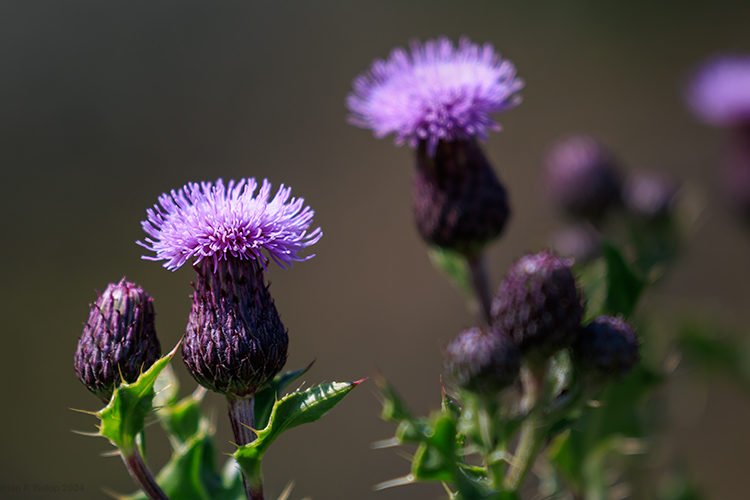
Cirsium arvense Creeping thistle
An older specimen here, flowers pretty much fully out. As I walked past these I thought this small group of flowers and buds offered an opportunity for a bit of ‘pretty’.
Photographically, I’ve used a smaller aperture here to try and give partial focus to the nearest buds and flower, whilst letting the rest form a bit background blur. I think it works and, as you know, it’s my site!
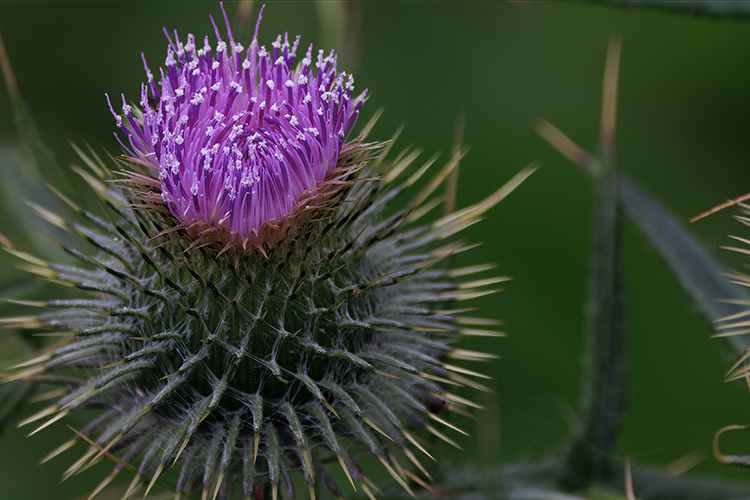
Cirsium vulgare Common or spear thistle
Aka: Spear thistle and, of course, Scottish Thistle. It is something of a national emblem, as well as being the national flower of Scotland. This apparently arises because apparently one of a group of stealthy (and presumably nasty) Norse invaders creeping barefoot for a secret attack on the sleeping Scottish army near Largs stood on one and cried out, waking and warning the army. Well, I’m no military strategist, but I would have though something like, well you know, a few dozen lookouts or sentries might have been a good idea. I suspect whisky may have been consumed Anyway, all this history is inspiring in a way, making it especially interesting the Highland council flail these down alongside everything else. I wonder if the local football team, Inverness Caledonian Thistle FC, know this?
Well, given that overall this plant it big, mostly stem and leaf (and thorn) I figured close-up was the way to go, after-all the flower is the only pretty bit of this species. I’m not really in love with this image, something doesn’t seem to ‘gel’. I’ll get some more next summer.
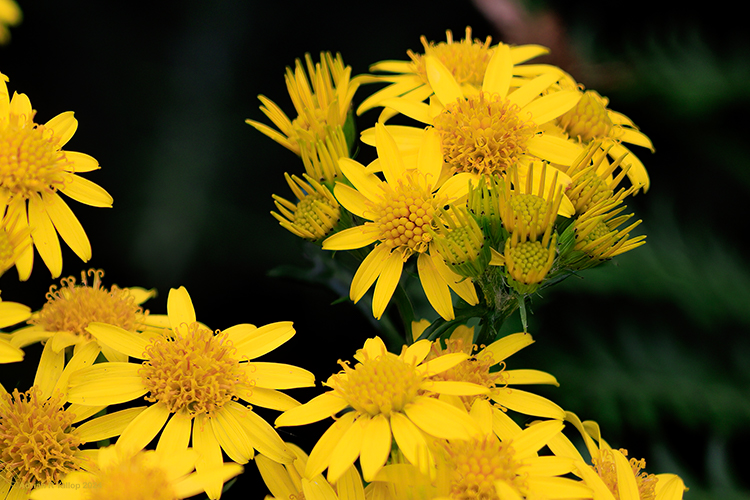
Senecio jacobaea Ragwort
I do like this plant (there I go again), but this time it’s more for the fascinating complex evolutionary web it weaves. Like many plants, Ragwort, produces toxic alkaloids to protect against herbivores. However, over time the larvae of the lovely Cinnabar moth evolved tolerance by chemically sequestering them, and so they carried on munching. That’s not all though, both larva and adult retain enough of these alkaloids to, in turn, serve a deterrent against their own predators. This led to both larvae and moth evolving warning colouration (aposematism, if you want a big word), black and yellow stripes in the larva and bright red forewings in the moth. But even that isn’t enough! Ragwort, now unprotected against this ravenous insect, essentially contracted out its protection to ants, which it attracts by producing excess sugary ‘treats’ from ‘organs’ called extra-floral nectaries. Nearly there! While searching for these, the ants also find all the juicy caterpillars, that they happily prey upon. Such complicated ‘coevolutionary arms races’ as they are called are widespread. Go look it up. Try here for starters, I did, many many years ago! :
⇢ click ⇠ n.b. this connects to the external site JStor: - it’s safe enough. You will need to sign-up for free access tho' to read it all. On such late night reading were my student years spent.
Oh, the picture? I like it!
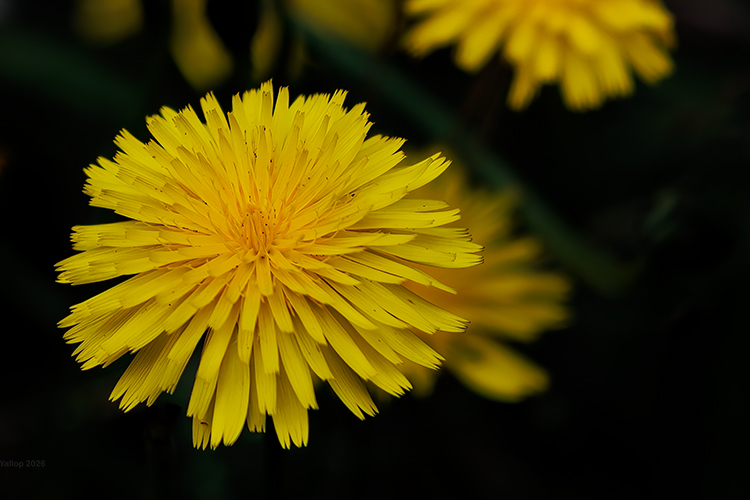
Hypochaeris radicata Cat's-ear
Well, if any plant helped me decide against wasting my time trying to become a field botanist it’s the likes of this one, and all his many many almost identical looking friends in the genus Taraxacum, a group of around 240 micro-species. Bah.
But look, he’s pretty! And that will do for me. The meadow where this chap lived was filled with thousands of these beautiful fragments of sunshine. Delightful. Only difficulty is choosing which one to photograph.
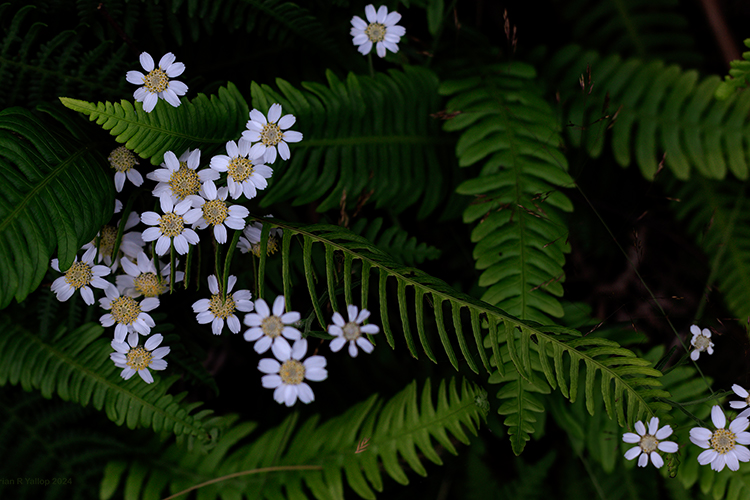
Achillea ptarmica Sneezewort
This lovely little group of flowers, sneaking though the fronds of what were probably Polypodium vulgare (but I didn’t confirm that, am I bad?). Like many of our flowers and plants somebody somewhere has chewed it, apparently it produces a numbing of the gums. So it got used for toothache. But of course its main common name is sneezewort, because it is said to induce, yes you guessed it, sneezing. How this interfered with its use as a toothache treatment is not clear, perhaps sneezing took your mind off the rotting tooth for a bit, or maybe you sneezed so hard your teeth flew out, solving the problem. Still a handy tip given NHS dentists are a thing of the past.
Anyway, I got a quick picture before I sneezed, blew my nose, and wandered on.
Calluna vulgaris Heather
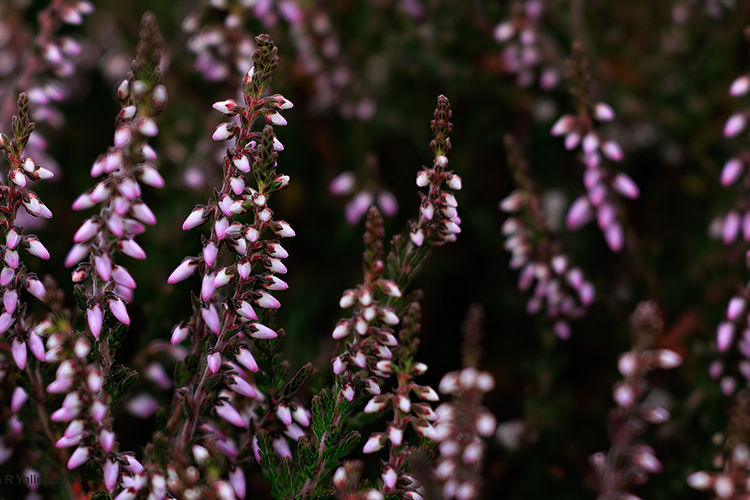
Well I guess it’s time to get to a couple of examples of a group that is ubiquitous in the uplands of Scotland and England, the Ericaceae, often called ‘heaths’ or heathers. Now as someone who spent too many years studying the symbiotic relationship between plant and fungi called mycorrhiza, I could tell you far more than you ever wanted to know about its occurrence in the ericales. But I won’t, because I’m nice!
When flowering, Calluna is a plant that looks stunning en mass covering many a hillside, but that’s a landscape photograph, not a flower one as far as I’m concerned. Get closer though and it is still tricky, just so so many tiny flowers. Each one on its own though doesn't look much, it needs its mates. So I’ve picked here a kind of third approach. To be honest I took quite a few, I’ve tried cropping all sorts of ways, the permutations are almost infinite. So I offer you this one, I sure it isn’t the best, but I don’t know which one is, bugger it!
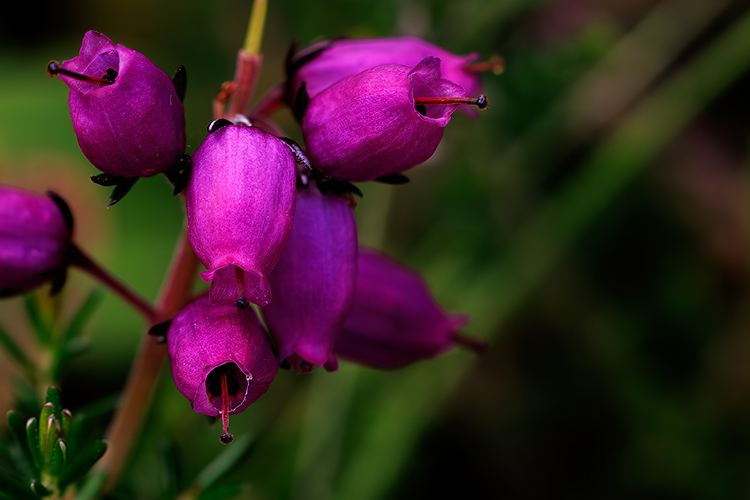
Erica cinerea Bell Heather
One of the usual co-residents alongside Calluna is of course its brighter more colourful cousin. Thing is it flowers sequentially on each stem, so where you’ve got some nice new examples you invariably have older ‘manky’ ones that quite ruin a picture. I’ve got loads where the odd grey ‘dead’ one quite spoils the effect. This little group though hadn’t got that far, although the bottom one is definitely on the ‘way out’, good job I found them when I did, another day and it would have looked terrible. I also like the contrasting burst of yellow provided by the out of focus Tormentil.
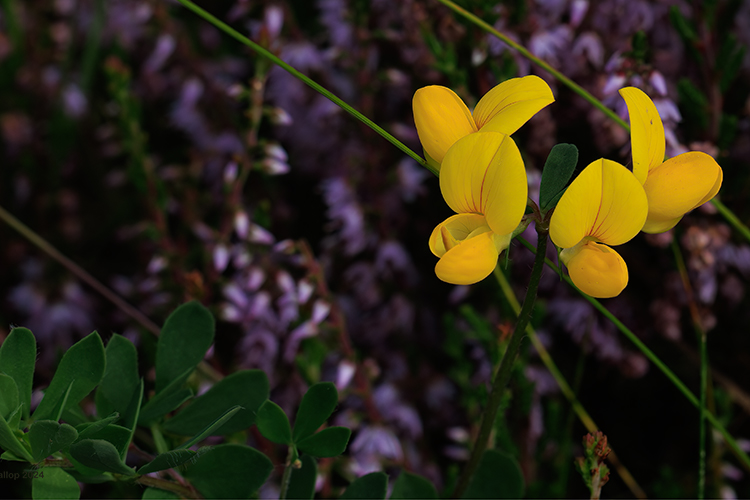
Lotus corniculatus Greater bird's foot trefoil
Another favourite, with the nice contrasting background heather providing an easy segue from the previous.
If you want to try an interesting taste sensation, just chew a few leaves of this pretty little plant. Now, part of that flavour is hydrogen cyanide, you know the famous deadly poison! Don’t worry, I ran that test on dozens and dozen unsuspecting Ecology 101 students over the years, no-one died, although many may have spat their tongues out. The amount is MINUTE.
But how come the plant doesn’t poison itself? Well I’m pleased you asked. It’s very cunning, in fact they invented ‘binary’ chemical weapons hundreds of thousands of years before the Pentagon. The plant produces the toxin as two safe precursors, one it stores in the cytoplasm, and the other in the vacuole, so they never meet. But, if leaf cells are chewed by a herbivore, caterpillar, snail or rabbit, these are mixed and voila, poison.
Pretty plant tho’.
Geranium robertianum Herb Robert
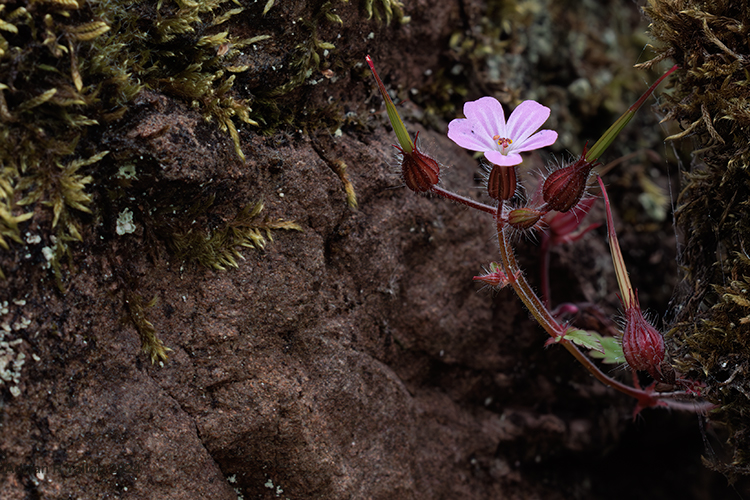
Now here’s a favourite of mine! Herb Robert, a delightful little flower that turns up everywhere, a true opportunist, usually looking all vulnerable and feeble. But with a pretty flower and, usually, nice deep red stems and leaves. Some, I am sure, would call it a ‘weed’, well ‘weed yourself’ is all I can say.
Finding one or two growing in a recess of an old cemetery wall give a prettier option than behind my bin, so I take a couple. This was a favourite, I think it ticks the ‘pretty’ box.
As you probably know, so why I am telling you, those seed heads give rise to the English family name of cranesbill. The scientific name Geranium, comes from the greek ‘géranos’, meaning, yes you guessed it ‘crane’.
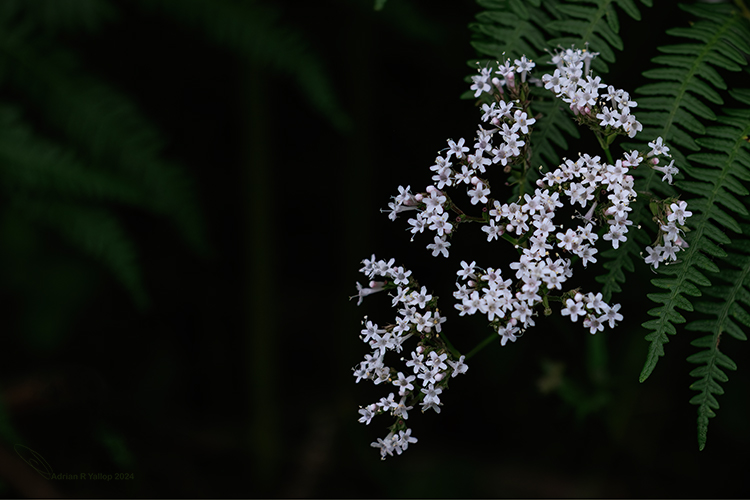
Valeriana officinalis Common valerian
Well I saw this little spray of common valerian, poking through some bracken fronds the previous day, it looked nice, but I had the wrong lens. So next day I’m back, and it looks just as pretty. So I take a few.
I’ve heard some people say the drug valium is related to this species. While chemically untrue, valerian is suggested to act as a naturopathic remedy for stress, as well as helping with sleep. It looks too pretty to smoke, so I leave it for others to appreciate and walk on.
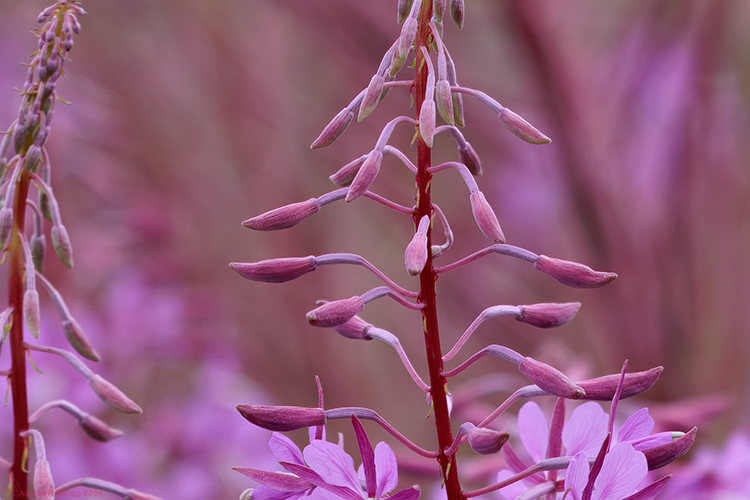
Rosebay willowherb or Fireweed
Here’s a plant I love ! And it’s from my past too (there's a lot of it). Nearly 700 moons ago (aaaargh!) I used to breed Elephant Hawkmoths, and they eat, yup, this plant. A big beautiful pink and green moth and a big beautiful pink and green plant. If you don’t know your moths go look it up, it’s a beauty. Oh, and its larvae are remarkable too, big fake large eyes, with a real small head on the end of a ‘trunk’, hence it’s name.
I do prefer the English name I’ve used here, although some call it fireweed, a name derived from the fact that, as a superb coloniser, it would grow in abundance on fire sites. It's famous in doing so in old WW2 bomb-sites too. However, it can also hold its ground, and large swathes provide glorious colour in later summer alongside the A9, greeting those driving north into Inverness.
Like Calluna, and other landscape ‘painters’, I feel incapable of capturing this species in all its metre and a half tall glory. And I have tried, trust me. I will give it a go again tho’ because I have such fond memories of it. In the meantime I offer this, the only one of about 50 that I took over a futile half and hour. Actually, I quite like it, it ignores the bulk of the plant, just showing unopened buds, yet still captures the pink and green theme of this plant (and moth!), I think.
I’ve also used my preferred scientific name. People are buggering about with the taxonomy again, I can’t be doing with it frankly. They’ll change their minds, or others will come along and change it for them soon. I’ll stick with Epilobium thank you, it was good enough for Linnaeus, and it’s good enough for me.